
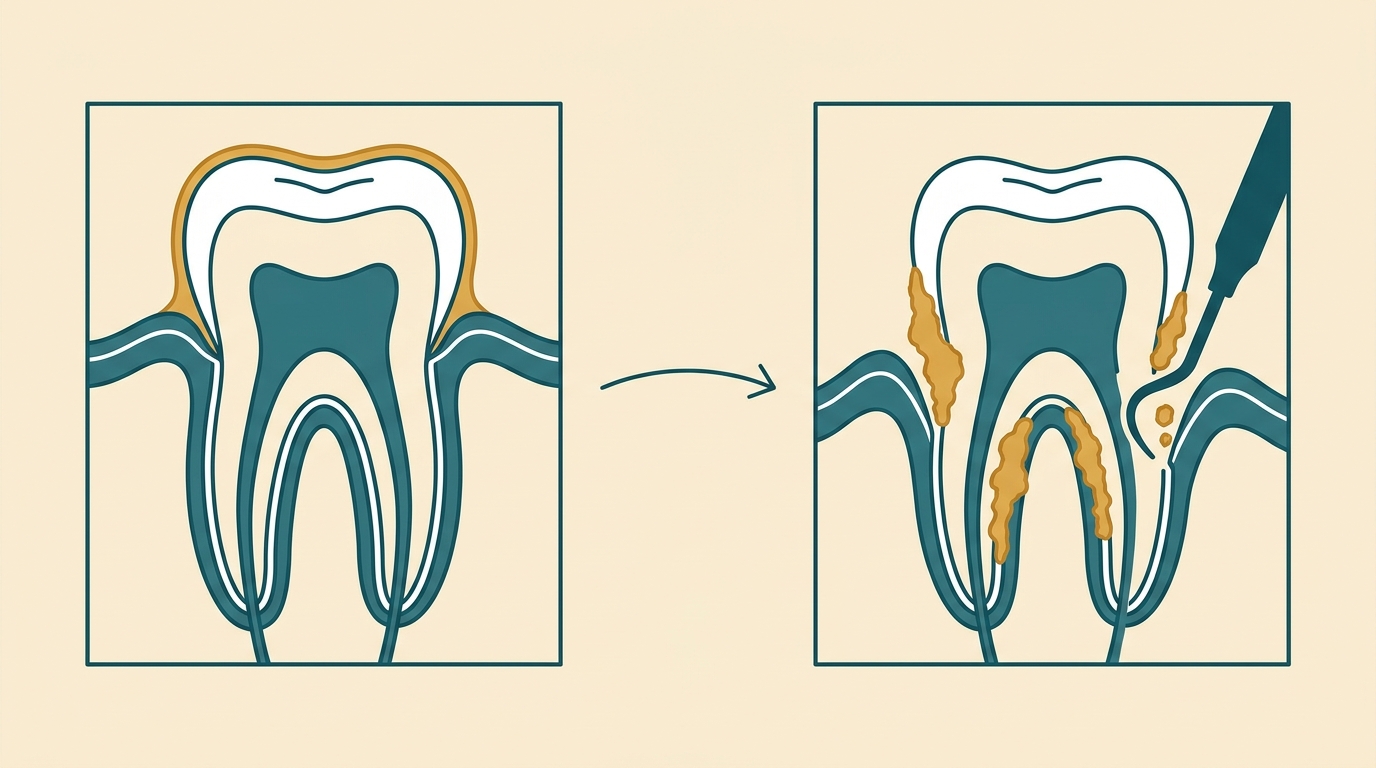
A regular dental cleaning (prophylaxis) is a preventive polish for healthy teeth and gums that removes plaque and tartar from tooth surfaces above the gumline. Scaling and root planing (SRP) is a therapeutic procedure for patients with gum disease that reaches below the gumline, removes buildup from the root surfaces, and smooths those roots so the gums can reattach. One keeps healthy mouths healthy; the other treats an active disease process.
If your hygienist recently mentioned a "deep cleaning," you're not alone in wondering whether it's genuinely necessary or just an upsell. The honest answer is that the recommendation should be driven by specific clinical findings — not a vague sense that your mouth needs "more." Here's what's actually different under the hood, and how to tell which one you need.
What is a regular dental cleaning, exactly?
A routine cleaning, called a prophylaxis, is the standard preventive visit for people with healthy teeth and gums. The hygienist removes plaque and tartar from the visible surfaces of your teeth above the gumline, polishes them, and typically finishes with a fluoride application. Most dental cleanings take 30 to 60 minutes, and most dentists recommend one every six months.
The prophylaxis is the most common type of dental cleaning, and it's designed to maintain a healthy baseline — not to treat disease that has already progressed. Beyond the obvious benefit to your teeth, regular dental cleanings can also help reduce the risk of heart disease, stroke, and dementia, which is why dentists push so hard on the six-month cadence. At Markiewicz Dental in Mundelein, cleanings and exams fall under the practice's General & Preventive services, alongside digital X-rays and periodontal evaluations that help flag changes early.
What is scaling and root planing?
Scaling and root planing is a non-surgical treatment for gum disease that works in two steps: scaling removes plaque and tartar from above and below the gumline, and root planing smooths the exposed root surfaces so the gum tissue can reattach to the tooth. Because the instruments work beneath the gumline, the dentist will numb the area first.
SRP is not simply a more thorough cleaning. The ADA classifies it as therapeutic rather than preventive, and its periodontal-treatment codes are specifically for patients who have been diagnosed with periodontal disease. It's indicated for patients with mild or moderate gum disease and can help sore, bleeding gums and prevent tooth loss.
How is SRP different from a regular cleaning, side by side?
The two procedures share tools and vocabulary but differ in purpose, depth, anesthesia, visit count, and aftercare. A regular cleaning is a maintenance visit; SRP is a treatment for diagnosed disease. The clearest way to see the gap is to put the key dimensions next to each other.
| Dimension | Regular Cleaning (Prophylaxis) | Scaling & Root Planing (SRP) |
|---|---|---|
| Purpose | Preventive maintenance | Therapeutic treatment for gum disease |
| Who it's for | Patients with healthy teeth and gums | Patients with mild or moderate periodontitis |
| Where it cleans | Above the gumline | Above and below the gumline, onto root surfaces |
| Anesthesia | None | Local anesthetic (gums are numbed) |
| Visits | Usually one | Often more than one |
| Typical duration | 30–60 minutes | Longer; often split by quadrants |
| Recommended frequency | Every 6 months | As prescribed, followed by periodontal maintenance |
How does your dentist decide which one you need?
The decision rests on three measurable clinical findings: pocket depth around each tooth, signs of inflammation such as bleeding on probing, and X-ray evidence of bone or attachment loss. Healthy gum pockets are usually about 1–3 mm; deeper readings can indicate periodontal disease, but depth alone is not a diagnosis — your dentist weighs it with the other signs.
If gum disease is caught early and hasn't damaged the structures below the gumline, a professional cleaning should suffice. If the pockets between the gums and teeth are too deep, scaling and root planing may be needed. This is where a diagnostic workup matters: Markiewicz Dental uses 3D CBCT imaging, AI-assisted X-ray interpretation, and 3D intraoral scanners to document what's happening below the surface, following the ALARA principle of taking X-rays only when diagnostically necessary and at the lowest dose that answers the clinical question.
Why in-house periodontics matters in Lake County
Many general practices refer periodontal cases out, which adds a second office, a second consultation, and often weeks of delay. Markiewicz Dental has four doctors practicing in one building and includes a board-certified periodontist on staff, so gum surgery, grafting, and complex implant work can be performed in-house without a referral. For patients coming from Mundelein, Libertyville, Vernon Hills, Hawthorn Woods, or Grayslake, that typically means fewer trips and a single team managing the full course of care.
What happens during and after SRP?
During SRP, your gums are numbed with a local anesthetic, and the hygienist or dentist uses hand instruments and ultrasonic scalers to clear plaque and tartar from below the gumline and smooth the root surfaces. Treatment may be split across more than one visit, often by quadrant. Depending on the case, the provider may inject antibiotics around the tooth roots, prescribe oral antibiotics, or place subantimicrobial-dose doxycycline directly into the cleaned pocket.
Afterward, expect some pain for a day or two and tooth sensitivity for up to a week. Your gums may be swollen, tender, and bleed slightly. The dentist will schedule a follow-up visit to see how the gums have healed and measure pocket depths again; if they've gotten deeper, more treatment may be needed.
Is SRP a one-time fix?
No. SRP treats active periodontal disease but does not cure it permanently. After the initial treatment, patients move to periodontal maintenance — follow-up care that is distinct from a regular prophylaxis and is scheduled more frequently to keep pocket depths stable and catch recurrence early. Skipping maintenance is the single most common reason SRP gains are lost.
For Mundelein patients, that ongoing cadence is easier to keep when the periodontist, hygienists, and general dentists share one chart under one roof. Markiewicz Dental has been serving Mundelein since 1988 and holds early appointments five days a week, with free parking at the door — practical details that matter when you're committing to a long-term maintenance schedule.
Frequently asked questions
Do I really need scaling and root planing, or can I just get a regular cleaning?
It depends on your clinical findings, not your preference. If your pocket depths are in the healthy 1–3 mm range with no bleeding on probing or bone loss, a regular cleaning is appropriate. If your dentist has documented deeper pockets, inflammation, or attachment loss on X-ray, SRP is a therapeutic recommendation — opting for a prophylaxis instead leaves active disease untreated.
Is scaling and root planing painful?
The procedure itself is done under local anesthetic, so your gums are numb during treatment. Afterward, you may have pain for a day or two and tooth sensitivity for up to a week, and your gums may feel swollen, tender, and bleed slightly. Most patients manage recovery with over-the-counter pain relief and a few days of softer foods.
How long does SRP take compared to a regular cleaning?
A regular cleaning typically takes 30 to 60 minutes in a single visit. Scaling and root planing often takes longer and may be split across more than one visit, commonly treating one or two quadrants of the mouth per appointment. The exact number of visits depends on how much tartar is present below the gumline and how many areas are affected.
What's the difference between SRP and periodontal maintenance?
SRP is the initial active treatment that removes buildup from root surfaces and smooths them so gums can reattach. Periodontal maintenance is the ongoing follow-up care that comes after SRP — scheduled more frequently than a standard six-month cleaning and designed to keep pocket depths stable. They use similar instruments but serve different clinical purposes.
Will my gums grow back after scaling and root planing?
Root planing smooths the tooth roots to help the gums reattach to the teeth, which can reduce pocket depth over the weeks following treatment. However, SRP does not regrow bone or tissue that has already been lost. At the follow-up visit, your dentist will re-measure pocket depths; if they haven't improved enough, additional treatment such as surgery may be discussed.
How common is the gum disease that requires SRP?
Chronic periodontitis — the advanced gum disease SRP is designed to treat — affects 47.2% of adults over 30 in the United States, according to data cited by the ADA's MouthHealthy resource. That makes it one of the most common chronic conditions in American adults, and it's a key reason dentists screen pocket depths and bleeding at every routine visit, not just when symptoms appear.
Getting a straight answer in Mundelein
If you've been told you need a deep cleaning and you want a clear explanation of why — with the pocket measurements, X-rays, and reasoning laid out — that's a reasonable thing to ask for before you agree to treatment. Readers in Mundelein who want this handled professionally can reach Markiewicz Dental at (847) 566-2811 or https://www.amdds.com to schedule an evaluation and get a straight answer about which type of cleaning fits their situation.