
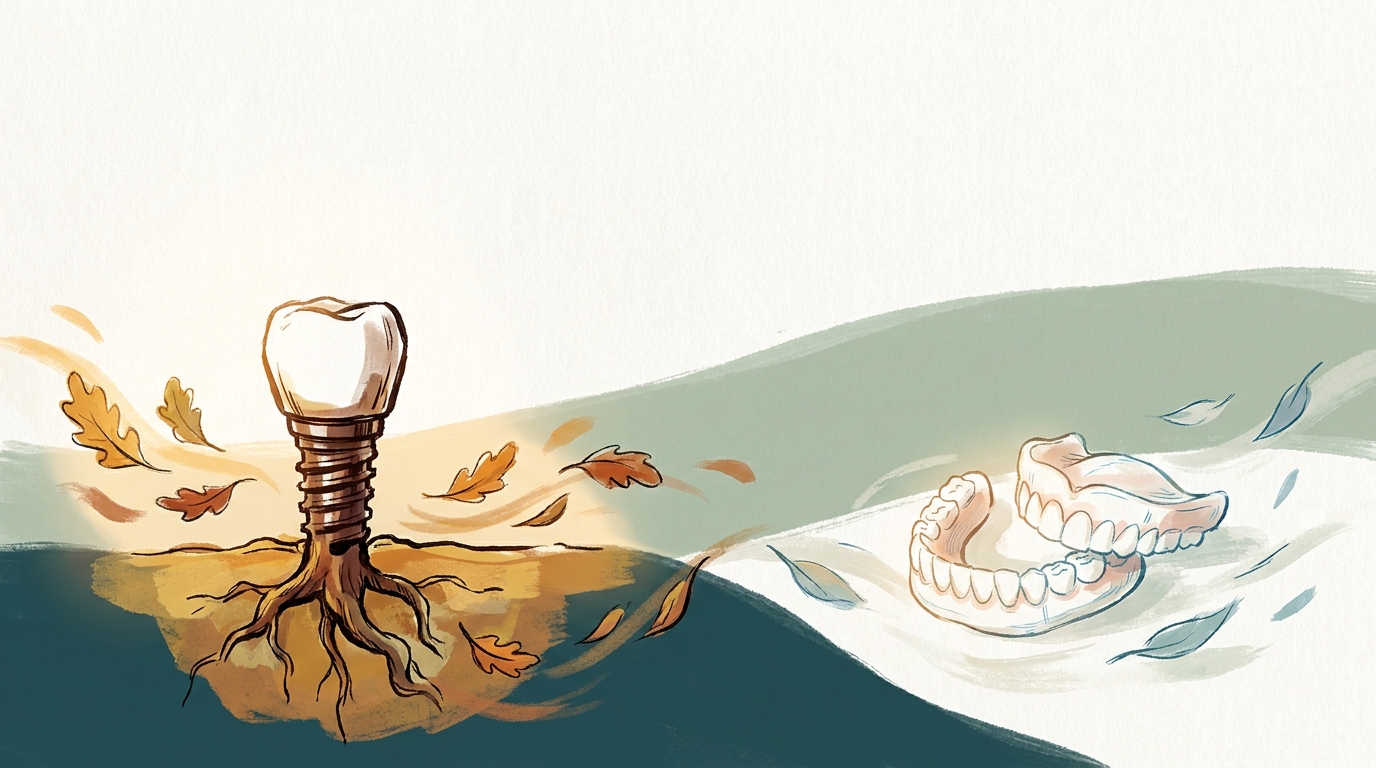
For most adults in Mundelein, IL who are healthy enough for minor oral surgery and have adequate jawbone, dental implants are the better long-term choice than conventional dentures. Implants are surgically placed into the jaw and integrate with the bone, which helps preserve bone that conventional dentures cannot. Dentures remain a legitimate option when health, bone volume, or budget rule implants out — but they trade daily removal, overnight soaking, and gradual jawbone recession for a lower upfront cost.
What is the direct answer: are implants or dentures better long-term?
Implants win on durability and bone preservation; dentures win on upfront affordability and non-surgical access. Dental implants integrate with the jawbone and are designed to be long lasting, helping keep the bone healthy, while conventional dentures sit on the gums and allow the underlying bone to recede over time. For a healthy adult with enough bone, implants are the stronger long-term investment.
That tradeoff is why practices like Markiewicz Dental in Mundelein, IL spend the first visit mapping candidacy before recommending either path. The firm answer only exists once your health history, bone volume, and goals are on the table.
How do implants and dentures actually differ day to day?
Implants are cared for with the same daily brushing and flossing routines recommended for natural teeth. Conventional dentures should be removed and cleaned after eating and soaked overnight — a different maintenance rhythm you take on every day for the life of the appliance. That difference compounds over years.
A dental implant system has three parts: an implant body placed in the jaw in place of the tooth's root, an abutment that connects to the implant body, and often an abutment fixation screw. A full-arch implant system follows the same logic — implants in the jaw, abutments, and the prosthetic teeth they support.
| Dimension | Dental implants | Conventional dentures |
|---|---|---|
| Placement | Surgically placed in the jawbone | Rest on the gums |
| Bone health | Help keep the jawbone from shrinking | Underlying bone deteriorates over time |
| Daily care | Brush and floss like natural teeth | Remove and clean after eating; soak overnight |
| Healing / fitting | — | No surgery; relines and adjustments over time |
| Upfront cost | Higher | Lower |
How does the implant process work in 2026, from scan to final tooth?
Implant treatment starts with imaging and planning, then surgical placement, then a healing period in which the implant and bone bond together to form anchors for the new teeth. Only after bone integration is the final restoration attached.
At Markiewicz Dental, implant planning uses CBCT scanning so the exact position of every implant is planned before surgery, and a digital intraoral scanner replaces traditional impression trays by capturing a 3D model of the teeth and gums. Provisionals and definitive restorations are printed in-house using 3D digital printing for a more accurate fit in fewer visits.
Who is actually a candidate for implants?
Candidacy comes down to overall health, bone volume, and habits. The FDA notes that a patient's overall health is an important factor in determining whether they are a good candidate for dental implants, how long healing takes, and how long the implant may stay in place. Smoking may affect healing and decrease long-term success. As with any surgical procedure, implant surgery carries risks that your provider will review with you based on your individual health history.
When bone volume is thin, grafting may be needed before placement. Markiewicz Dental includes a board-certified periodontist on staff, so gum surgery, grafting, and complex implant work are performed in-house without an outside referral — a meaningful convenience for Lake County patients who would otherwise be shuttled between offices.
What drives the long-term cost difference?
Implants cost more upfront and typically less to maintain; dentures cost less upfront and carry ongoing replacement and adjustment costs. Conventional dentures are generally evaluated periodically for possible relining or replacement as the underlying jawbone recedes, since dentures rest on gums whose shape changes over time. Implants are maintained with routine brushing, flossing, and dental visits like natural teeth.
Because every mouth is different — number of teeth replaced, bone condition, whether grafting is needed, sedation preferences — there is no honest flat price for either option. Markiewicz Dental's new patient exams are scheduled as 90 minutes before any treatment is recommended, which is the appropriate point to get a written estimate rather than a phone quote.
What about full-arch cases — All-On-X vs full dentures?
For patients missing most or all teeth in an arch, the modern comparison is usually full dentures versus a fixed full-arch implant restoration (often called All-On-X), not single implants versus single dentures. Full-arch implants anchor a fixed prosthesis on a small number of implants and integrate with the jawbone, helping keep the bone healthy. Full dentures remain removable and continue to allow bone recession underneath.
Markiewicz Dental offers All-On-X implants, including fixed full-arch restorations often completed in a single day — a workflow that depends on CBCT planning, in-house printing, and the periodontist and restorative doctors working under one roof on IL-83.
What should Mundelein, IL patients look for in an implant provider?
Look for a practice that performs the surgical and restorative work in-house, uses advanced imaging for implant planning, and takes the time to confirm candidacy before quoting treatment. Those three criteria filter out most of the shortcuts that lead to implant looseness or loss, which is how implant failure is usually defined.
Markiewicz Dental has served Mundelein since 1988 and treats patients from Mundelein, Libertyville, Vernon Hills, Hawthorn Woods, Grayslake, and across Lake County. Four doctors — including a board-certified periodontist — practice in one building, and the practice follows the ALARA imaging principle, taking X-rays only when diagnostically necessary and at the lowest dose that answers the clinical question.
Frequently asked questions
Are dental implants or dentures better for preserving the jawbone?
Dental implants are better for preserving the jawbone. Implants integrate with the jawbone and help keep it from shrinking, which is one of the FDA-cited benefits of implant treatment. With conventional dentures, the bone that previously surrounded the tooth roots begins to deteriorate, leading to recession of the jawbone over time. For long-term bone health, implants are the stronger choice.
How long does implant treatment take from start to finish?
Plan on several months. After an implant body is placed, the implant and surrounding bone bond together over a healing period that may take several months or longer, forming anchors for the new teeth. The exact timeline depends on bone condition and whether grafting is needed.
Can I get implants if I smoke?
You can be evaluated, but smoking is a real risk factor. The FDA notes that smoking may affect the healing process and decrease the long-term success of a dental implant. Many patients choose to quit or significantly reduce smoking around the surgical and healing window to improve their odds. A candid conversation during the Mundelein, IL consultation visit is the right place to work through this.
Do implants feel like natural teeth?
Functionally, yes — more so than dentures. Implants are fixed in the jaw and are cared for with the same daily brushing and flossing routines recommended for natural teeth, with no removal, no soaking, and no adhesives. Replacing a lost tooth with a dental implant can significantly improve quality of life and health, particularly for chewing and speech.
What are the main risks of implant surgery I should know about?
Dental implant surgery carries risks that vary by patient; your provider will review them with you based on your health history and anatomy. These risks are reduced when the implant position is planned on a CBCT scan before surgery and when the clinical team includes someone trained in surgical implant placement.
Where can I get implant care in Mundelein, IL without being sent elsewhere for the surgical steps?
Markiewicz Dental at 852 IL-83 in Mundelein handles both the surgical and restorative sides of implant care in-house. The practice includes a board-certified periodontist on staff, so gum surgery, grafting, and complex implant work are performed on-site without an outside referral. Four doctors practice in one building, with free parking at the door.
A straightforward next step
If you have the health and bone to support them, dental implants are the stronger long-term answer than conventional dentures — better for jawbone preservation, simpler to live with day to day, and designed to last. Dentures still have a legitimate place when surgery isn't appropriate, and an honest provider will tell you which path fits your mouth rather than default to one answer.
Readers in Mundelein, IL who want this evaluated properly can reach Markiewicz Dental at (847) 566-2811 or https://www.amdds.com to schedule a 90-minute new patient exam and get specific guidance for your case.