
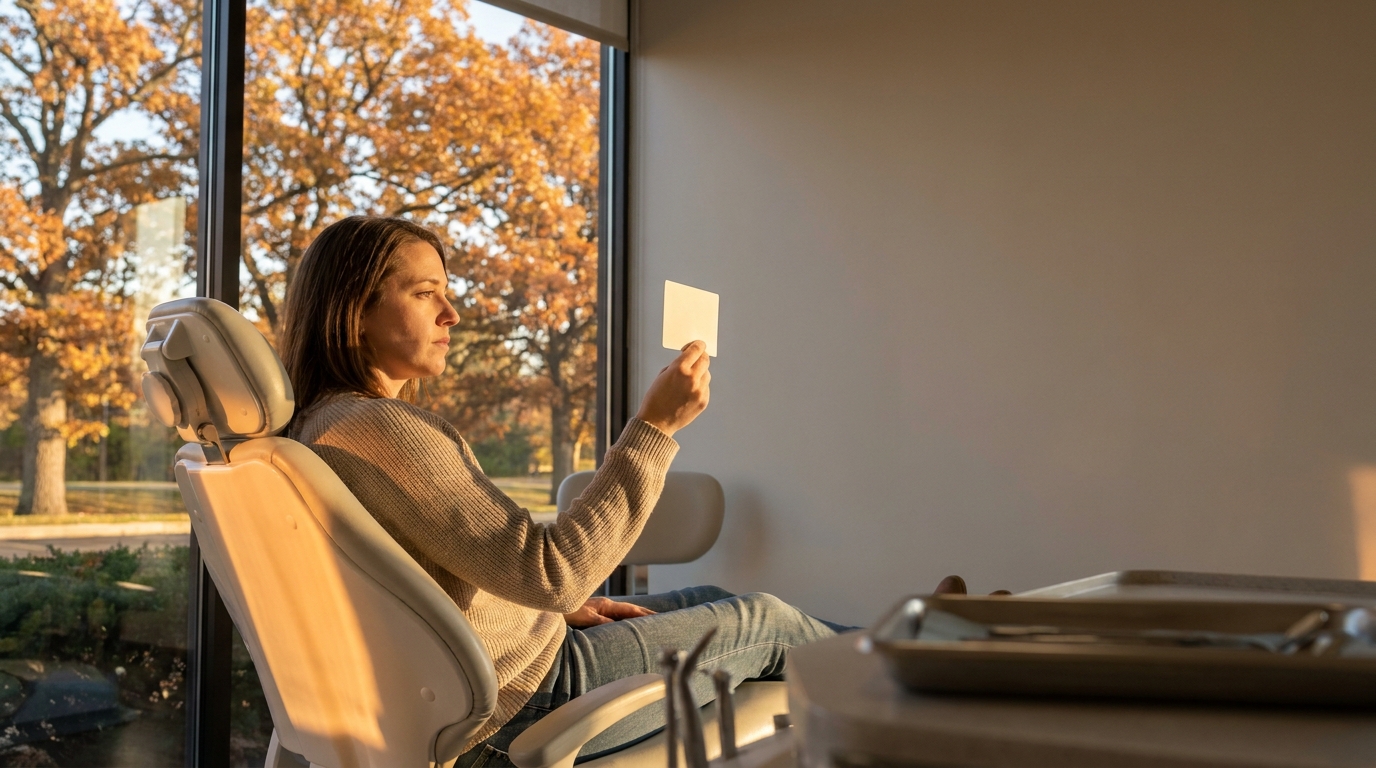
Here's the honest version: professional teeth whitening in Mundelein, IL is a dentist-supervised bleaching treatment using hydrogen peroxide or carbamide peroxide, and In-office chairside bleaching is performed at the dental office under dentist supervision. It lightens natural tooth structure only — it will not change the color of caps, veneers, crowns, or fillings — and it will not reliably fix every kind of discoloration, no matter what the box at the drugstore promises.
The myths around whitening are loud. They sell a lot of strips, LED mouthpieces, and charcoal powders. They also send a steady stream of disappointed patients into our Mundelein practice wondering why their smile didn't match the before-and-after photos. The truth is more useful than the marketing, and it's what this guide is for.
Myth: "Any yellow, brown, or gray stain will whiten if you use a strong enough gel."
Not true. According to the American Dental Association's consumer resource, yellow teeth will probably bleach well, brown teeth may not respond as well, and teeth with gray tones may not bleach at all. Color type predicts outcome more than concentration does — which is why a candidacy exam matters before anyone spends money on a treatment.
Age plays into this too. With increasing age, enamel becomes more translucent and thinner, which lets the yellower dentin underneath show through and the overall tooth color darken. That's intrinsic discoloration, and it generally responds to peroxide. Extrinsic stains — the ones from coffee, tea, red wine, cola, tobacco, and certain metal salts — also respond well. Whitening treatments can be effective on both extrinsic and intrinsic staining, but the shade you start with sets a realistic ceiling on the shade you finish with.
Myth: "Whitening will fix my old crown or that dark front filling too."
No. Only natural teeth can be whitened — caps, veneers, crowns, and fillings will not change color with bleaching treatments. This is the single most common surprise in cosmetic consultations: a patient whitens successfully, then realizes the crown on a front tooth now looks darker than everything around it because the natural teeth moved and the restoration didn't.
For patients in Mundelein and the surrounding Lake County communities, this is where sequencing matters. If restorations on visible teeth are in your future — or already present — the whitening decision and the restoration decision need to be made together. Whiten first to the target shade, let the color stabilize, then match new crowns, veneers, or composite fillings to that shade. Markiewicz Dental plans these two steps together so patients aren't paying to redo a restoration later.
Myth: "If my adult teeth are discolored from childhood medication, a stronger whitening session will fix it."
Partly wrong, and the nuance matters. Whitening will not be effective if tooth discoloration is caused by medications. Discoloration caused by medications during tooth development can behave very differently from extrinsic staining like coffee stain.
They can sometimes be improved, but "improved" is not "erased." For many of these patients, the honest conversation is about veneers or bonding rather than bleaching. That conversation is part of what a proper exam exists to do.
Myth: "Drugstore kits do the same thing as in-office whitening, just slower."
Same active ingredients, very different delivery. Carbamide peroxide and hydrogen peroxide are commonly used across the whole category, and they can readily permeate dental hard tissues — both agents can readily permeate dental hard tissues, which is why the delivery system and proper gum protection matter so much. That speed is also why the delivery system matters so much.
The ADA groups whitening into three tiers: in-office bleaching, dentist-supplied take-home products, and over-the-counter whiteners. Here's how they actually differ:
| Option | Oversight | Typical sessions | Gum protection |
|---|---|---|---|
| In-office chairside bleaching | Dentist-supervised | Usually one office visit | Protective gel or rubber shield applied |
| Dentist-supplied take-home | Custom trays from a dentist | Multiple at-home sessions over days or weeks | Custom-fit trays limit gum contact |
| Over-the-counter | None | Daily use over weeks | One-size strips or trays; variable |
During in-office bleaching the dentist applies either a protective gel to the gums or a rubber shield before the whitening gel touches anything. That is not cosmetic theater. Incorrect application or gel contact with soft tissue can cause irritation or burns, which is exactly why regulators and the ADA both point patients toward a dentist assessment before whitening.
Myth: "If my teeth hurt after whitening, something went wrong."
Usually not. Temporary tooth sensitivity and gingival inflammation are the most common adverse effects of vital tooth whitening, and they typically resolve on their own. What a good provider does is minimize them — screen for untreated cavities or exposed root surfaces first, use appropriate concentrations, isolate the gums, and give you a plan for the day or two after.
What is not normal: sharp pain on a single tooth, a tooth that darkens instead of lightens, or burning gum tissue hours after the appointment. Those are signs the mouth needed something addressed before the bleach went on. This is part of why the exam comes first.
Myth: "Whitening is purely cosmetic, so an exam is overkill."
The exam is the part that separates a good outcome from an expensive mistake.
Markiewicz Dental, which has been serving Mundelein since 1988, schedules new patient exams as 90 minutes before any treatment is recommended. That length exists for a reason: whitening candidacy is a small part of a broader look at whether your mouth is ready for an elective procedure. Patients come to the practice at 852 IL-83 from Mundelein, Libertyville, Vernon Hills, Hawthorn Woods, Grayslake, and across Lake County, and the exam is the same disciplined starting point for all of them.
So what should Mundelein patients actually expect?
Expect a conversation first, a treatment second, and a honest shade prediction based on the stain type you actually have. Expect one in-office visit for chairside bleaching, with gum protection in place before any gel is applied. Expect some temporary sensitivity. Expect results that fade over time if the coffee, tea, red wine, and tobacco habits that caused the staining come back.
And expect the plan to account for anything restorative on your front teeth — because the crown that looked fine last year will look different against a brighter natural shade.
Frequently asked questions
How long does in-office professional whitening take?
In-office chairside bleaching usually requires only one office visit. The appointment itself typically runs about an hour, including gum protection, gel application, and shade evaluation. Take-home trays dispensed by a dentist work more gradually over days or weeks. Your dentist will recommend the delivery method that fits your stain type, sensitivity history, and schedule.
Will whitening work on my veneers or crowns?
No. Only natural teeth can be whitened — caps, veneers, crowns, and fillings will not change color with bleaching. If you have restorations on visible teeth, plan the whitening and the restorations together. Whiten first to your target shade, let the color settle, then match any new crowns, veneers, or composites to that shade so everything looks uniform.
Is tooth sensitivity after whitening normal?
Yes, within limits. Temporary tooth sensitivity and gingival inflammation are the most common adverse effects of vital tooth whitening and typically fade within a day or two. Sharp pain in a single tooth, lingering gum burning, or a tooth that darkens instead of lightens is not normal and should be evaluated by your dentist.
Can whitening fix tetracycline or medication stains?
Sometimes partially, not always fully. Whitening generally will not be effective when tooth discoloration is caused by medications. Medication-related stains can be difficult to improve with bleaching alone, and even partial results may take extended treatment. For many of these cases, veneers or bonding produce a more predictable cosmetic outcome than bleaching alone.
How long do professional whitening results last?
Results are not permanent. How long they last depends on your habits — extrinsic staining is primarily associated with tobacco use and consumption of pigmented foods and beverages like red wine, coffee, tea, and cola. Patients who cut back on staining inputs and keep up with routine cleanings generally hold their results longer and need fewer touch-ups over time.
Do I need an exam before whitening, or can I just book the treatment?
An exam first. Untreated cavities, gum disease, exposed roots, or a single traumatized tooth can all affect whether whitening is appropriate and how comfortable it will be. Markiewicz Dental schedules new patient exams as 90 minutes before any treatment is recommended, which gives time to evaluate candidacy and sequence any restorative work alongside the cosmetic plan.
If you want this handled professionally in Mundelein
Whitening is one of the simplest cosmetic treatments in dentistry when it's done on the right patient, for the right stain, with the right protection in place. It's also one of the easiest to get wrong when it's bought off a shelf and applied over a problem that should have been diagnosed first. Readers in Mundelein, IL who want whitening evaluated as part of a real exam can reach Markiewicz Dental at (847) 566-2811 or https://www.amdds.com to get started.