
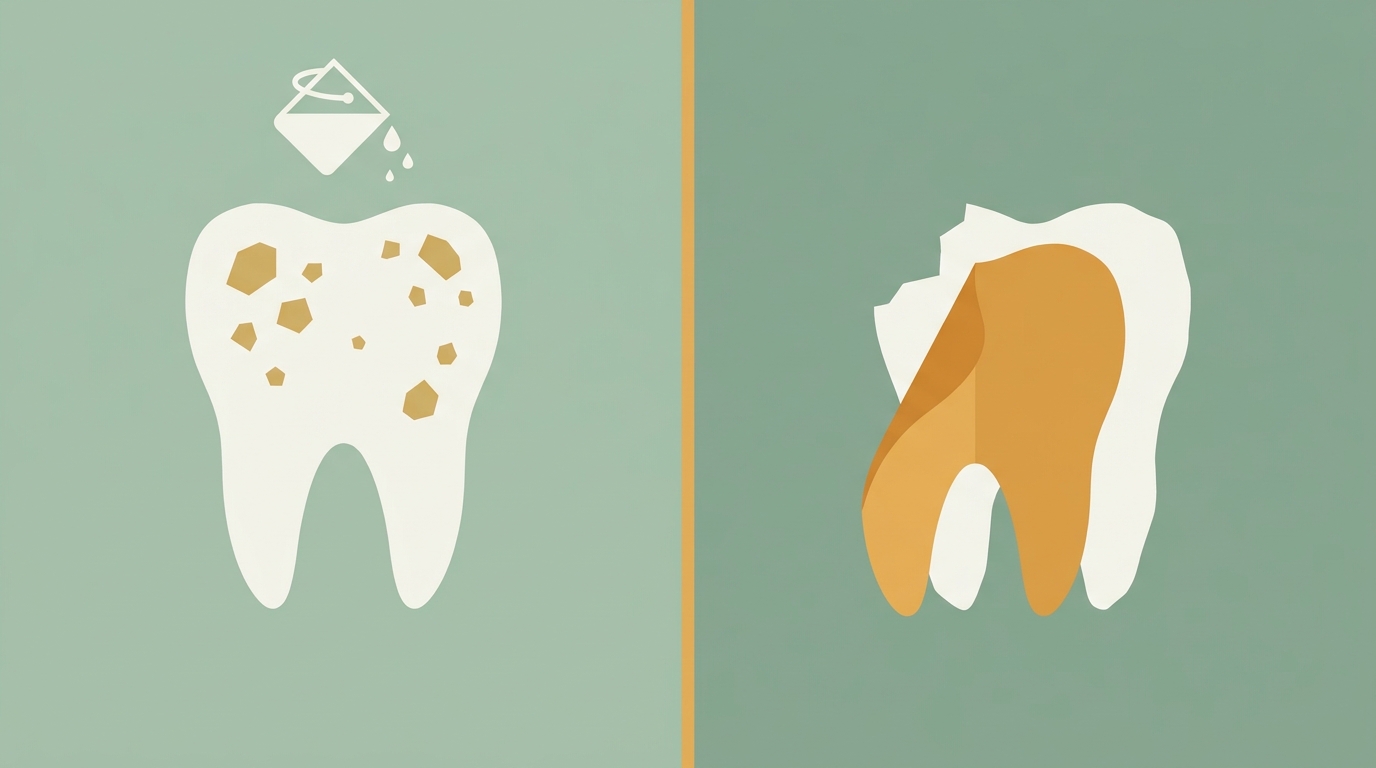
The common belief is that veneers and teeth whitening are two routes to the same brighter smile, and the only real question is which costs less. That's wrong. Whitening lightens the color of natural teeth; veneers are thin shells bonded to the fronts of teeth that change color, shape, and size — and placing them is not reversible. If color is your only concern, whitening is almost always the right first conversation. If you're also unhappy with chips, gaps, or shape, whitening alone can't get you there.
Do veneers and teeth whitening actually solve the same problem?
No. Whitening uses bleaching agents to lighten natural tooth enamel and does nothing to shape, align, or rebuild teeth. Veneers cover the front surface of a tooth to change its appearance, including color, shape, and size. They're different categories of treatment, and choosing between them starts with naming the problem — color alone, or color plus structure.
The myth comes from the fact that both treatments can make a smile look brighter. But bleaching only works on natural tooth structure. According to the American Dental Association, only natural teeth can be whitened — tooth-colored restorations like crowns, bonding, and existing veneers won't change shade. That alone rules whitening out as a fix for anything beyond discoloration of real enamel.
What does professional teeth whitening actually do?
Professional whitening uses peroxide-based gels — in-office, in dentist-supplied take-home trays, or in over-the-counter form — to lighten both surface stains and deeper discoloration inside the tooth. Results depend on the cause of the discoloration and the individual tooth, and some staining — such as that related to medication, injury, or genetics — may not respond fully.
The chemistry is faster than most patients expect. That's why dentist-supervised products can out-perform drugstore kits — the active ingredient and concentration are matched to your teeth.
The ADA notes that whitening can cause temporary tooth sensitivity and gum irritation. Both typically resolve, but they're the reason a dentist should screen for decay or gum disease before you start. In Mundelein, Markiewicz Dental handles that screening as part of a 90-minute new patient exam before recommending any cosmetic work.
What do dental veneers actually do — and what are the trade-offs?
Veneers are custom shells bonded to the front surface of a tooth to improve appearance. Veneers can address teeth that are chipped, broken, stained, crooked, or misshapen, and can mask gaps. Unlike crowns, they cover only the front of the tooth, not the whole structure.
The trade-off that most patients underestimate: veneer treatment is not reversible, because tooth enamel is removed to place them. Veneers can also chip, crack, wear, or loosen over time and may need to be re-bonded, repaired, or replaced. If you clench or grind your teeth or have a deep overbite, veneers may not be the right choice at all — a working bite assessment matters before any shells get ordered.
There are two main types: porcelain and composite. Porcelain is strong, long-lasting, natural-looking, and generally the more expensive option. Composite typically requires less enamel removal and fewer visits. And because veneers are considered cosmetic, insurance usually doesn't cover them unless they're deemed medically necessary.
Which one is right for your smile?
Start with whitening if your teeth are healthy, well-shaped, and well-aligned, and your only complaint is color. Choose veneers when the issue goes beyond shade — chips, gaps, uneven edges, worn fronts, or discoloration that bleaching won't lift. For many patients in Mundelein and across Lake County, the honest answer is to try whitening first and reassess; it's cheaper, non-invasive, and gives you a baseline.
A few deciding factors are worth checking against your own situation:
- Existing restorations. If you have crowns, bonding, or tooth-colored fillings on front teeth, whitening will create a shade mismatch — those don't bleach.
- Age-related darkening. With age, enamel thins and becomes more translucent, letting the yellower dentin show through. Whitening can help; severe cases may need veneers.
- Source of staining. Extrinsic staining from tobacco, pigmented foods, or metal salts generally responds well to bleaching. Deep intrinsic staining from medication, trauma, or genetics may not.
- Bite and grinding. A deep overbite or a clenching habit changes whether veneers are a durable option.
- Underlying issues. Decay or gum disease must be treated before veneers go on, or the problem gets sealed in and worse.
How do veneers and whitening compare side by side?
The clearest way to see the difference is a direct comparison on the dimensions that actually drive the decision: what problem each solves, how invasive it is, and whether the result is reversible.
| Dimension | Professional Teeth Whitening | Dental Veneers |
|---|---|---|
| What it fixes | Color of natural teeth only | Color, shape, chips, gaps, size |
| Works on restorations? | No — only natural enamel | Yes — veneers replace the visible surface |
| Reversible? | Yes | No — enamel is removed |
| Delivery options | In-office, dentist take-home, OTC | Porcelain or composite |
| Common side effects | Temporary sensitivity, gum irritation | May chip, crack, or loosen over time |
| Insurance | Typically not covered (cosmetic) | Usually not covered unless medically necessary |
| Best candidate | Healthy teeth, color-only concern | Multiple cosmetic concerns, stable bite |
What should you look for in a cosmetic dentist in Mundelein in 2026?
Look for a practice that examines before it recommends, uses modern imaging to plan the work, and shows you real patient results rather than stock photos. For cosmetic cases especially, you want a dentist who treats whitening and veneers as different tools for different problems — not interchangeable upsells.
Markiewicz Dental has been serving Mundelein since 1988 and has worked with four generations of local families. The practice has four doctors in one building, including a board-certified periodontist on staff, so if a cosmetic plan uncovers a gum issue it can be handled in-house without a referral. Markiewicz Dental's smile gallery features only real patient cases photographed in the practice, with no stock photography and no digital retouching — which matters when you're trying to picture your own result.
On the diagnostic side, the practice uses 3D intraoral scanners instead of traditional impression trays, AI-assisted X-ray interpretation as a second set of eyes on every image, and in-house 3D digital printing for provisionals, night guards, and definitive restorations. For patients weighing veneers, that in-house capability matters: fewer visits, more control over fit, and the ability to iterate on temporaries before committing.
Frequently asked questions
Is whitening cheaper than veneers?
Yes, almost always. Whitening — whether in-office, custom take-home trays, or over-the-counter — is a bleaching treatment with no permanent change to the tooth. Veneers are custom restorations that involve lab work, enamel removal, and bonding, which puts them in a different cost category. For a current fee specific to your case in Mundelein, ask the practice for a written quote after an exam.
Can I whiten my teeth if I already have veneers or crowns on my front teeth?
Bleaching won't change the color of veneers, crowns, bonding, or tooth-colored fillings — only natural enamel responds, per the ADA. If you whiten your remaining natural teeth, your existing restorations will stay their current shade and may no longer match. Plan the sequence with your dentist: whiten first, then match any new restorations to the lightened shade.
Do veneers ruin your natural teeth?
Veneer placement removes some tooth enamel, which makes the treatment non-reversible. That doesn't mean teeth are "ruined," but it does mean you're committing to maintaining or replacing the veneers long-term. Veneers can chip, crack, wear, or loosen and may need to be re-bonded, repaired, or replaced. If you grind your teeth or have a deep overbite, discuss alternatives before proceeding.
How long does professional whitening take to work?
It depends on the delivery method. In-office treatments show results in a single visit, while dentist-supplied take-home trays typically brighten gradually over one to two weeks of nightly use. Over-the-counter products generally work more slowly and primarily on extrinsic surface staining. A dentist can match the method to your staining pattern and sensitivity level.
Will insurance cover veneers or whitening?
Usually not. Both are considered cosmetic dentistry, and veneers specifically are not typically covered by dental insurance unless deemed medically necessary — for example, to restore a broken or badly damaged tooth. Whitening is virtually always out-of-pocket. Ask your plan directly, and ask the practice for an itemized treatment plan you can submit for a pre-determination.
What causes teeth to darken in the first place?
Two broad categories. Extrinsic staining comes from outside sources — tobacco, pigmented foods and drinks, and exposure to certain metal salts. Intrinsic changes happen inside the tooth, including age-related thinning of enamel that lets the yellower dentin show through, as well as medication, trauma, or genetic factors. The source of the discoloration shapes which treatment will actually work for you.
The bottom line
Whitening and veneers aren't two prices for the same result — they're different treatments for different problems. If your teeth are healthy and well-shaped and you just want them lighter, start with professional whitening. If the problem is also shape, chips, gaps, or stains that won't bleach out, that's a veneer conversation, and it deserves an exam first.
Readers in Mundelein who want a straight answer on which option fits their smile can reach Markiewicz Dental at (847) 566-2811 or https://www.amdds.com to schedule a new patient exam at 852 IL-83.