
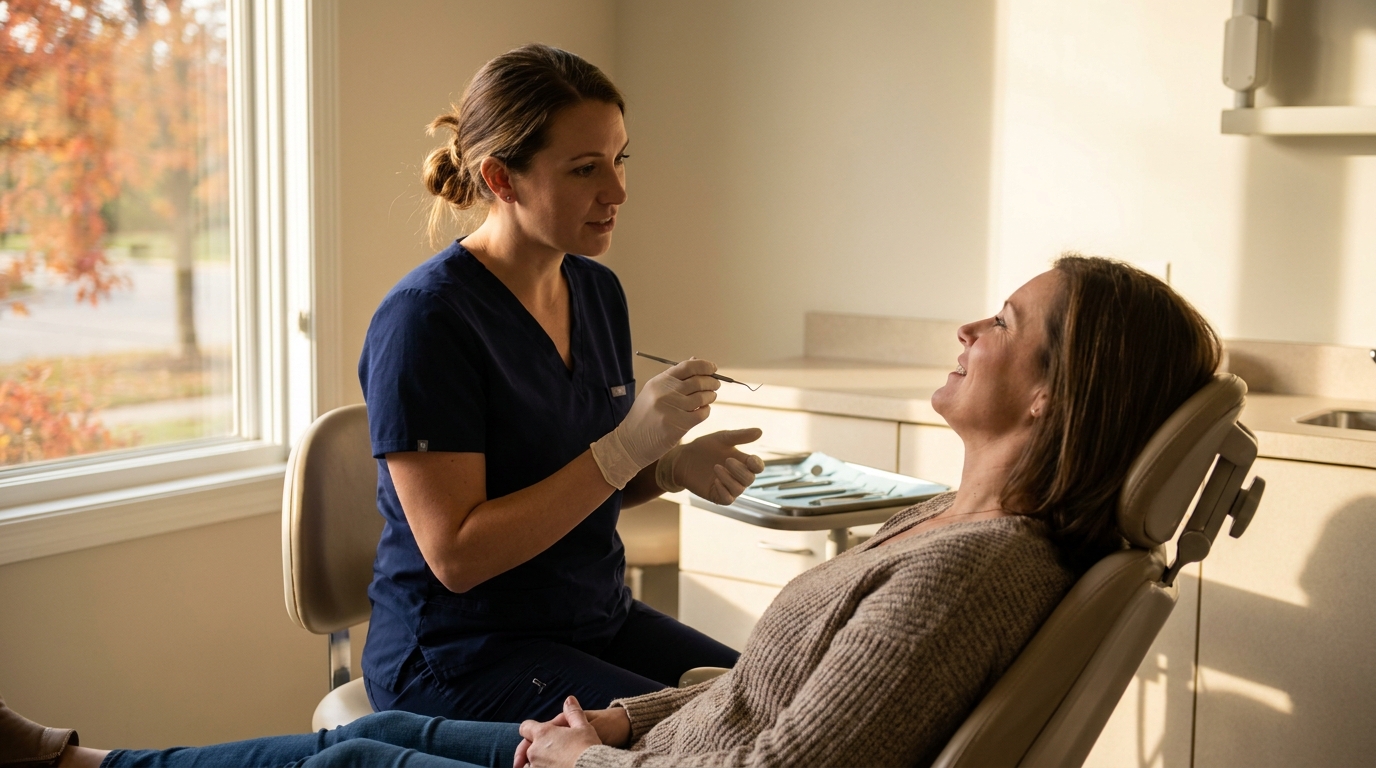
Your first dental visit in Mundelein, IL is a comprehensive new patient exam: a thorough tooth-by-tooth check, a periodontal evaluation that measures the gum pocket depth around every tooth, an oral cancer screening, a review of digital X-rays, and a professional cleaning. You leave with a plain-language, prioritized plan — what needs attention now, what's being watched, and what can wait.
That's the short answer. The longer answer is worth reading, because a first visit is where a dental relationship is either built or quietly undermined. Below is what actually happens, step by step, and why each step matters to your long-term oral health.
Why is the first visit different from a regular checkup?
A first visit at Markiewicz Dental is described as a more extensive version of the standard cleaning and checkup — a comprehensive new patient exam. The clinical steps overlap with a routine visit, but the dentist is building a baseline from scratch: your gum measurements, your bite, your bone levels, your medical and medication history, and any work you've had done elsewhere. That baseline is what every future visit gets compared against.
Markiewicz Dental has served Mundelein from 852 IL-83 as a family-owned, never-corporate practice, with four doctors — including a board-certified periodontist — practicing in one building. That matters on a first visit because gum findings or complex restorative questions can be handled in-house rather than kicked to an outside referral.
What happens during the clinical exam?
The clinical exam covers every tooth for decay, cracks, and wear; a periodontal evaluation measuring the pocket depth around each tooth; an oral cancer screening of your gums, soft palate, throat, and neck; a bite and jaw evaluation; and a review of digital X-rays. The dentist then explains what was found and recommends any additional work needed before you leave the chair.
At Markiewicz Dental, that exam is supported by 3D CBCT imaging, intraoral scanners, dental microscopes, and AI-assisted X-ray interpretation that gives a second set of expert eyes on every image. The point of the technology isn't novelty — it's catching the small cracks, early decay, and bone changes that a once-over at a chain office often misses.
What are gum pocket numbers, and why do they matter?
During gum probing, a periodontal probe is gently inserted between the tooth and gum, and the pocket depth is measured in millimeters at six places around each tooth. Readings of 1–3 mm are generally considered healthy, 4 mm is borderline, 5–6 mm indicates gum disease, and 7 mm or more indicates advanced gum disease. Unchecked pockets deepen, trap plaque and bacteria, and eventually damage the bone holding the tooth in place.
Those numbers are the single most honest readout of your long-term oral health at a first visit — and most patients hear them called out without knowing what they mean. Markiewicz Dental's hygiene team puts it this way:
After more than 20 years of cleaning teeth here, the question I wish every new patient asked me is "What are my gum numbers?" During your first visit, I measure the pockets around each tooth, and those numbers tell us more about your long-term health than almost anything else. Most people hear me calling them out and have no idea what they mean. Ask! I love explaining it, and it's the best way to know whether your gums are healthy or need attention. The second is "How often should I actually be coming in?" Twice a year is the standard, but it's not right for everyone. Some patients do better every three or four months, especially if they have a history of gum disease. And if your gums need more care, our in-house periodontist, Dr. Bogard, offers free consultations, which a lot of people never think to ask about. New patients also don't realize they can ask to see what I see. We can pull up your X-rays and intraoral photos right on the screen. It's one thing for me to tell you there's buildup or a crack forming. It's another to see it yourself. And if you don't have insurance, ask about our membership plan. It covers your preventive care for the year, and every plan even includes an electric toothbrush. Finally, tell me about your medications, any sensitivity, or even a dry mouth. Patients often think it's not dental-related, but it all affects what I see and what I recommend. The more you tell me, the better I can take care of you.— Brittany Whiting, Dental Hygienist, Markiewicz Dental
How are X-rays handled on a first visit?
The American Dental Association's current guidance is that dental imaging should be ordered when clinically necessary rather than on a fixed schedule, and that any prior images should be reviewed before new ones are taken. In other words: bring records from your previous dentist if you have them, and expect your new dentist to ask for them.
Markiewicz Dental follows the ALARA principle, taking X-rays only when diagnostically necessary and at the lowest dose that answers the clinical question. If 3D imaging is needed — for example, to plan an implant — CBCT scanning lets the exact position of every implant be planned before surgery, rather than discovered during it.
What does the cleaning involve, and how often should you come back?
For most patients, a dental cleaning and checkup is recommended every six months. Patients with active gum disease, a history of frequent cavities, or other risk factors may be placed on a three-to-four-month recall schedule instead, because gum disease re-establishes below the gumline on roughly that timeline. Six months is the practical standard most dentists work from.
The cleaning itself removes the hardened buildup a toothbrush can't reach, especially along and just under the gumline. If your pocket numbers come back in a range that calls for a different approach, the cleaning may be scaled differently — and your hygienist will tell you so, in plain language, before starting.
What should the plan you leave with look like?
You should leave with a prioritized, plain-language plan: what needs attention now, what's being monitored, and what can wait. Ask to see your X-rays and intraoral photos on the screen — seeing a crack or buildup yourself is very different from being told it's there. If something is being watched rather than treated, you should know exactly what change would move it into the "treat now" column.
| Finding on first visit | What it usually means | Typical next step |
|---|---|---|
| Pocket depths 1–3 mm | Healthy gums | Standard cleaning every 6 months |
| Pocket depths of 4 mm | Borderline — early inflammation | Targeted hygiene, closer monitoring |
| Pocket depths 5–6 mm | Gum disease present | Deeper cleaning, 3–4 month recall |
| Pocket depths 7 mm or more | Advanced gum disease | Periodontal treatment, possible surgery |
| Suspicious area on X-ray | Possible decay or crack | Restoration or monitoring with photos |
What should anxious or first-time Mundelein patients do differently?
If dental visits make you tense, say so before the exam starts — not after. Ask for a brief tour, ask the hygienist to narrate what she's doing, and ask to see your own images on the monitor as findings are explained. Patients who understand what's happening tolerate it far better than patients who are left guessing.
So Glad Dr David Markiewicz took me on as a new patient. The office staff was gracious and gave me a tour. Tammy was so professional and explaining to me every procedure she was doing. Dr David took time to review my X-rays in detail. Great experience— George, 5★, Sep 2026
Markiewicz Dental holds an average 5.0 Google rating across more than 700 patient reviews, and the doctors maintain memberships with the Academy of General Dentistry, American Dental Association, Illinois State Dental Society, Spear Education, The Pankey Institute, and the American Academy of Implant Dentistry — useful markers when you're sizing up a new practice.
Frequently asked questions
How long does a first dental visit usually take?
That window covers paperwork, digital X-rays, a tooth-by-tooth exam, periodontal measurements at six points around each tooth, an oral cancer screening, a cleaning, and time for the dentist to walk you through the findings and the plan before you leave.
Should I bring my old X-rays to the first appointment?
Yes. The ADA's guidance confirms that prior images should be reviewed before deciding whether new X-rays are needed. Bringing recent X-rays from a previous dentist can reduce unnecessary imaging on your first visit and gives your new dentist a comparison point for anything being monitored.
At what age should my child have a first dental visit?
Delta Dental guidance recommends that children begin dental visits by their first birthday, or soon after their first tooth appears. Early visits are less about treatment and more about acclimating the child to the chair, the lights, and the people — which makes every future visit easier.
Will I get a cleaning on my first visit?
Usually yes. A first visit at Markiewicz Dental is described as a more extensive version of the standard cleaning and checkup, so a professional cleaning is part of it. If your gum measurements show pockets that call for a different type of cleaning, that approach may be adjusted — your hygienist will explain any change before starting.
What should I tell the dentist that patients often forget?
Mention every medication you take, any sensitivity you've noticed, dry mouth, grinding or clenching, headaches on waking, and anything that's happened dentally since your last visit — even if it seems unrelated. Medications and dry mouth in particular change what the hygienist sees and recommends, and they're the details new patients most often leave out.
How often should I come back after the first visit?
For most patients, every six months. If your first-visit findings show active gum disease, a history of frequent cavities, or other risk factors, a three-to-four-month recall is often recommended instead — because gum disease re-establishes below the gumline on roughly that timeline, and catching it early is far easier than reversing it later.
The bottom line
A good first visit is diagnostic, not transactional. You should leave knowing your gum numbers, having seen your own X-rays, and holding a short, prioritized plan written in words you understand. If you're in Mundelein, IL and want that handled by a family-owned practice with general dentistry and periodontics under one roof, Markiewicz Dental can be reached at (847) 566-2811 or https://www.amdds.com to schedule a new patient exam.