
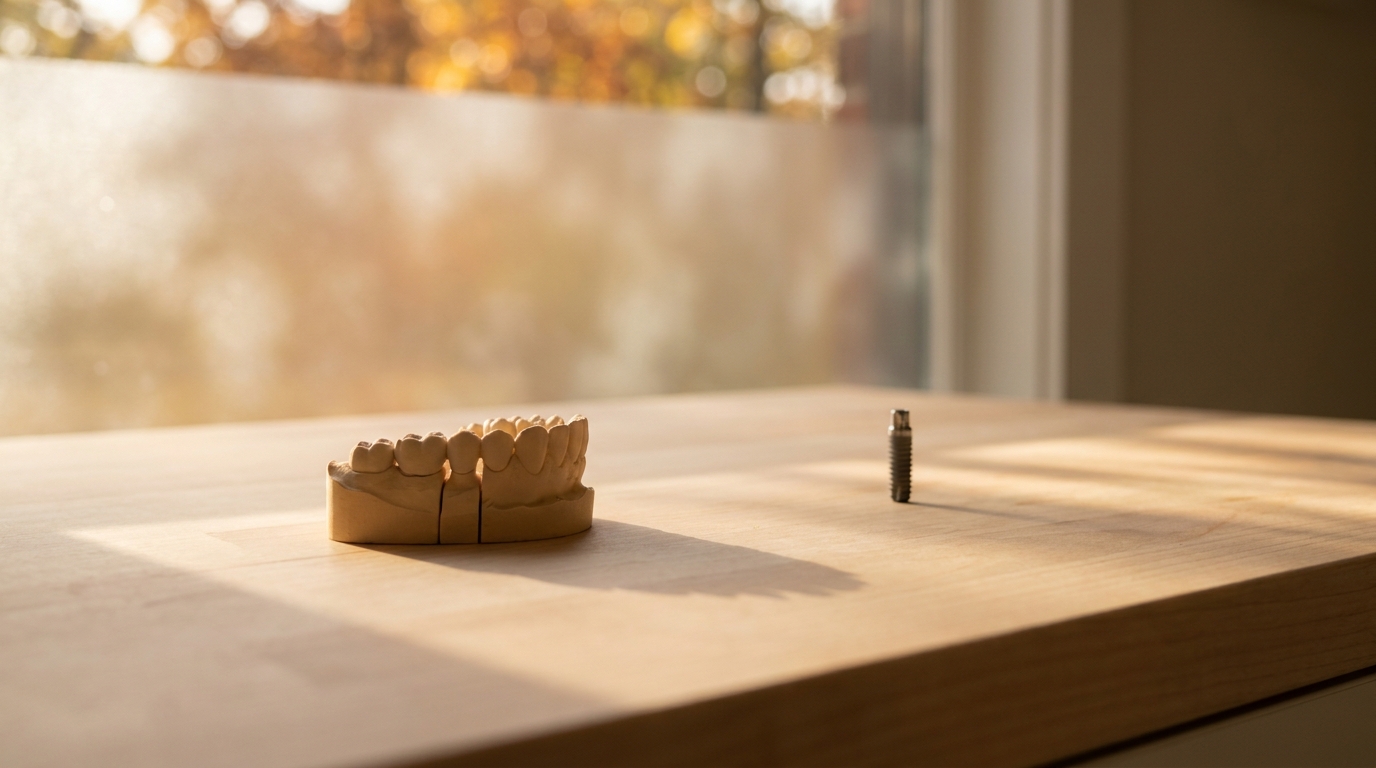
For a single missing tooth between two healthy teeth, a dental implant is usually the longer-lasting choice because it replaces the root and preserves bone, while a dental bridge is often the faster, less invasive choice when the neighboring teeth already need crowns or when implant surgery isn't a good fit. The right answer for you depends on the health of those adjacent teeth, your jawbone, your overall health, and your timeline.
Both options are legitimate. Both are well-established. And both have real trade-offs that a clinical exam and imaging will clarify before any decision is final.
What's the quick answer — implant or bridge for a single missing tooth?
Choose a dental implant when the teeth on either side of the gap are healthy and untouched, and you have enough jawbone to support the post. Choose a bridge when those neighboring teeth already need crowns, when you want to avoid surgery, or when bone quality rules out an implant. A clinical exam is required either way.
At Markiewicz Dental in Mundelein, new patient exams are scheduled as 90 minutes before any treatment is recommended, which gives both you and the doctor time to walk through the trade-offs rather than guess at them. That's the step where the decision actually gets made.
How does a dental implant differ from a dental bridge, mechanically?
A dental implant is a titanium post surgically placed into the jawbone; it fuses to the bone through osseointegration and supports a crown on top. A dental bridge, sometimes called a fixed partial denture, uses crowns on the teeth beside the gap as abutments to hold a pontic — the artificial tooth — in the middle. One replaces the root; the other spans the gap.
That mechanical difference drives almost every other difference between the two. An implant stands alone and stimulates the bone the way a natural root does. A bridge borrows strength from the neighboring teeth, which means those teeth share the chewing load — and the long-term wear.
Which option is better for the health of your other teeth?
An implant is generally kinder to the rest of your mouth because it doesn't require touching the adjacent teeth. A traditional bridge may require reshaping of the healthy teeth on either side of the gap to seat the crowns, and that reshaping is irreversible. If those neighbors are already crowned or heavily restored, a bridge uses structure that's already compromised; if they're pristine, an implant preserves them.
When a bridge actually protects the adjacent teeth
If the teeth beside the gap already need crowns — large fillings failing, cracks, prior root canals — a bridge rolls three restorations into one connected unit and avoids a separate surgery. Bridges also prevent remaining teeth from shifting after tooth loss, which matters because a drifted bite is harder (and more expensive) to correct later.
What are the main types of bridges, and when is each used?
There are three common designs, and the choice is driven by where the gap is and what teeth are available to anchor it. A traditional dental bridge is the most common type, used when there are healthy natural teeth on both sides of the gap. A cantilever bridge is used when adjacent teeth exist on only one side of the gap. A Maryland bridge uses metal or porcelain wings bonded to existing teeth.
| Bridge type | Best use case | Key limitation |
|---|---|---|
| Traditional | Healthy teeth on both sides of the gap | Requires reshaping both adjacent teeth |
| Cantilever | Only one adjacent tooth available | Not as strong as traditional bridges due to the design |
| Maryland | Front teeth, conservative prep | Typically used to replace front teeth and not strong enough to withstand the chewing forces of back teeth |
| Implant-supported | Multiple teeth missing, want to avoid crowning neighbors | Requires surgery and healing time |
Bridges can be made from gold, alloys, porcelain, or a combination of these materials, with porcelain and porcelain-fused-to-metal being the most common for visible teeth.
How long does each option last?
Dental bridges can last many years, depending on bite forces, hygiene, and the health of the supporting teeth. Dental implants can preserve bone structure and are described as a potentially lifetime solution when well-maintained, though the crown attached to the implant may need replacement over time. Neither number is a guarantee for any individual case.
Longevity isn't just about the device — it's about what fails first. Bridges often fail at the supporting teeth (decay under a crown, root fracture). Implants most often fail at the gum or bone level, which is why ongoing periodontal care matters.
What drives the cost difference in Mundelein?
An implant typically costs more up front than a bridge because it involves surgery, a healing period, imaging, the implant itself, an abutment, and a final crown. A bridge involves fewer visits and no surgery, so it's usually less expensive at the start — but if it needs replacement in 10–15 years, the lifetime cost can close the gap.
Specific pricing depends on your anatomy, materials, insurance, and whether procedures like bone grafting are needed. For a current quote in Mundelein, Markiewicz Dental will walk you through the numbers at the exam rather than guess remotely.
What should Mundelein patients look for when choosing a provider?
For single-tooth replacement, look for a practice that can handle both options under one roof, uses advanced imaging for implant planning, and has a periodontist available for anything involving the gums or bone. That combination matters because the right answer sometimes changes mid-exam — and you don't want a referral loop to decide it.
Markiewicz Dental has four doctors practicing in one building, offering both general dentistry and periodontics in-house, and includes a board-certified periodontist on staff — so gum surgery, grafting, and complex implant work can be performed in-house without a referral. The practice uses CBCT scanning for implant planning, allowing the exact position of every implant to be planned before surgery, and follows the ALARA principle for imaging, taking X-rays only when diagnostically necessary and at the lowest dose that answers the clinical question.
Markiewicz Dental has served four generations of Mundelein families, with some patients having been with the practice since its first year in 1988. The practice also serves patients from Libertyville, Vernon Hills, Hawthorn Woods, Grayslake, and families across Lake County — useful if you're weighing which practice is actually accessible for the multiple visits an implant case requires.
What local factors in Mundelein should influence the decision?
Winter in Lake County is a practical factor people underestimate. An implant case involves several appointments spread across months of healing, and northern Illinois weather between December and March can disrupt that schedule — which is why many Mundelein patients prefer to start implant work in late spring or early summer when travel is reliable.
Access matters too. Markiewicz Dental is located at 852 IL-83 in Mundelein, offers free parking at the door, and holds early appointments five days a week, which makes multi-visit treatment easier to fit around work in the Route 60 and Route 83 corridor.
Frequently asked questions
Is a dental implant always better than a bridge?
No. An implant is often the longer-lasting choice for a single missing tooth between healthy teeth, but a bridge can be the better option when adjacent teeth already need crowns, when you want to avoid surgery, or when bone quality or systemic health rules out an implant. The right answer requires a clinical exam and imaging.
Can a bridge be removed and replaced with an implant later?
Yes, but it's not simple. A fixed bridge can only be removed by a dentist, and once removed, the previously reshaped teeth may need new crowns regardless of what replaces the pontic. If an implant is on the table at all, it's usually better to decide before the bridge is placed, since bridge prep is irreversible.
What is an implant-supported bridge?
An implant bridge attaches artificial teeth directly to the jaw or under the gum tissue, using implants rather than natural teeth as the anchors. Its success depends on the foundation, making it important to keep remaining teeth healthy and strong. It's typically used when several adjacent teeth are missing and you want to avoid crowning the natural teeth on either end.
How long does the implant process take from start to finish?
Timelines vary by case, but single-tooth implants commonly take several months from placement to final crown because the titanium post needs time to fuse to the jawbone through osseointegration. A traditional bridge, by comparison, is often completed in two to three visits over a few weeks. Your exam and imaging will give you a realistic timeline for your mouth.
What can cause a dental implant to fail?
Recognized risk factors include poor bone quality or quantity, infection, smoking, systemic health conditions like uncontrolled diabetes, and poor oral hygiene. This is why implant planning depends on advanced imaging and a thorough health review before surgery is scheduled, and why a periodontist on staff is useful if gum or bone issues come up during the workup.
Will insurance cover an implant or a bridge?
Coverage varies by plan. Many dental plans cover a portion of bridges as a standard restorative procedure, while implant coverage is less consistent and often capped. Annual limits, waiting periods, and exclusions vary by plan and should be confirmed directly with your insurer before you commit to a treatment plan.
The bottom line for Mundelein patients
If the teeth on either side of your gap are healthy, an implant is usually worth the extra time and up-front cost for the way it preserves bone and leaves neighboring teeth alone. If those neighbors already need crowns, a bridge is often the smarter, faster path. The exam is where that call gets made with real information instead of guesses.
Readers in Mundelein who want this handled professionally can reach Markiewicz Dental at (847) 566-2811 or https://www.amdds.com to schedule the 90-minute new patient exam and see which option actually fits your mouth.