
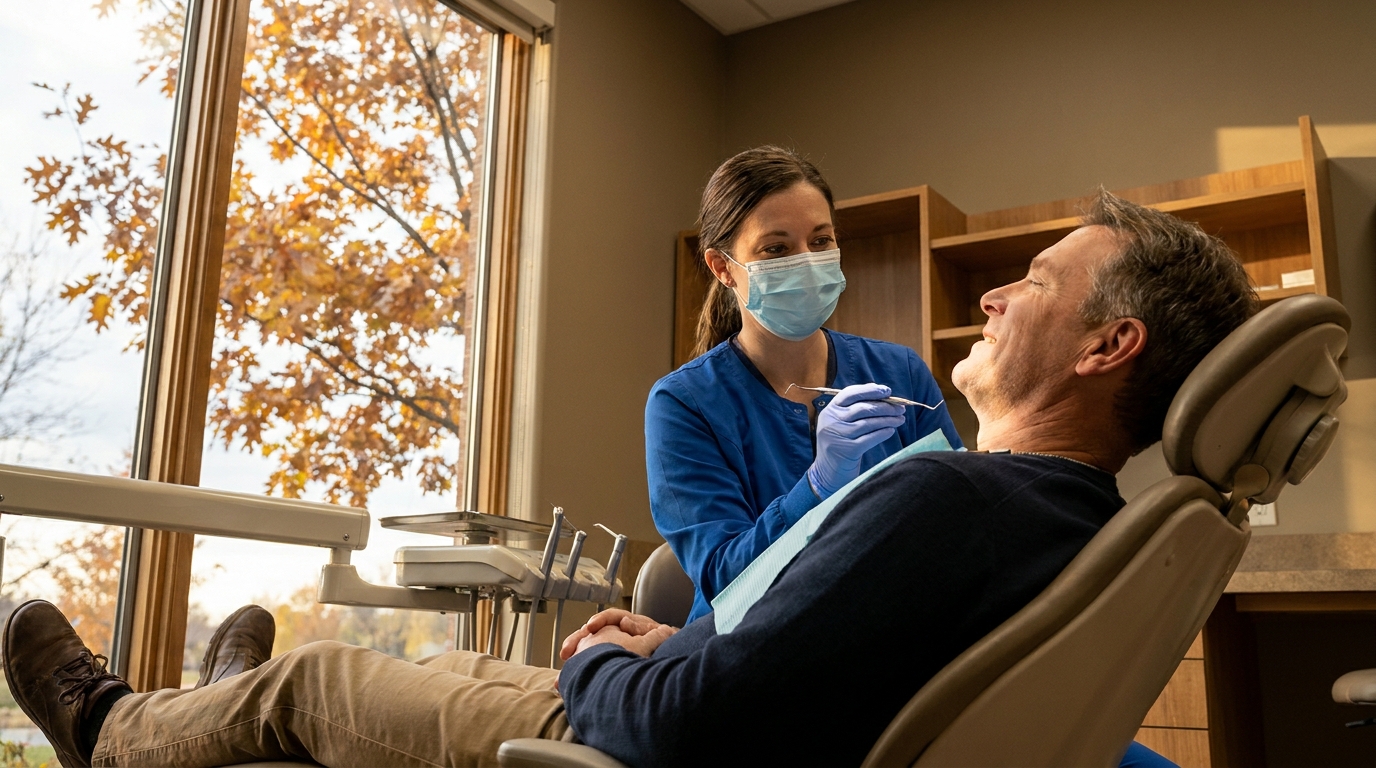
Periodontics is the branch of dentistry focused on preventing, diagnosing, and treating diseases of the gums and the structures that hold your teeth in place — the periodontal ligament, cementum, and alveolar bone — as well as placing dental implants. For Mundelein, IL patients, that means everything from a routine gum evaluation at a cleaning to scaling and root planing, grafting, and implant work for advanced cases.
The field matters more than most people realize. About 4 in 10 U.S. adults 30 years or older had some level of periodontitis in 2009–2014, and roughly 60% of adults 65 years or older had it. Gum disease is common, often quiet, and well worth understanding before it becomes a problem.
What does periodontics actually cover?
Periodontics is defined as the specialty of dentistry that encompasses prevention, diagnosis, and treatment of diseases of the supporting and surrounding tissues of teeth and dental implants. In plain terms: everything that keeps your teeth anchored — gums, ligament, cementum, and jawbone — plus the implants that replace teeth when those structures fail.
At Markiewicz Dental in Mundelein, periodontal care sits inside the General & Preventive category alongside exams, cleanings, and 3D imaging, and extends into surgical work when a case calls for it. The practice has four doctors in one building offering both general dentistry and periodontics in-house, which means most patients can have their gum care handled without a separate referral across town.
Who in Mundelein, IL needs periodontal care?
Anyone with signs of gum disease — bleeding gums, recession, persistent bad breath, loose teeth, or deep pockets measured at a dental exam — is a candidate for periodontal care. Risk rises with age: about 1 in 2 men and 1 in 3 women age 30 and older had some level of periodontitis in the 2009–2014 CDC data, and prevalence climbs with every decade after that.
Gum disease can often become serious before a person notices symptoms, which is why routine evaluations matter even when nothing feels wrong. During a periodontal evaluation, a small instrument called a probe is placed between teeth and gums — in the periodontal pockets — to measure their depth. Those numbers, along with bleeding and bone levels on X-rays, drive the diagnosis far more than how your mouth feels day to day.
What's the difference between gingivitis and periodontitis?
Gingivitis is reversible gum inflammation; periodontitis is not. Gingivitis is largely preventable and treatable with a combination of routine oral hygiene and professional cleanings, and if caught early it typically resolves. Periodontitis involves bone loss around the teeth and is an irreversible condition that can be slowed down and managed with professional treatment — but not fully reversed.
The practical takeaway for Lake County patients: the window where gum disease is easy to fix is the gingivitis window. Once bone is lost, the goal shifts from cure to control — keeping the disease stable, keeping teeth in place, and preventing further damage. Gingivitis, if left untreated, can progress to periodontitis, which is why consistent cleanings matter.
How is periodontal disease treated?
Treatment ranges from non-surgical cleanings to surgical reconstruction, depending on severity. Core periodontal services include scaling and root planing (cleaning the infected surface of a tooth's root), root surface debridement (removing damaged root tissue), oral inflammation treatment, and cosmetic periodontal procedures. More advanced cases may need gum grafting, bone grafting, or implant placement to replace teeth already lost.
| Stage | What's happening | Typical approach |
|---|---|---|
| Gingivitis | Gum inflammation, no bone loss; reversible | Professional cleaning plus improved home care |
| Early to moderate periodontitis | Pocket depths increasing, early bone loss | Scaling and root planing, periodontal maintenance |
| Advanced periodontitis | Significant bone loss, mobile teeth | Surgical therapy, grafting, possible implants |
| Post-treatment | Disease controlled, structures stabilized | Ongoing periodontal maintenance for life |
After active treatment, patients move into periodontal maintenance (procedure code D4910), which is performed following periodontal therapy and continues for the life of the dentition, according to the ADA's Code on Dental Procedures and Nomenclature. Coverage intervals and benefit limitations vary by plan — worth checking with your insurer before scheduling.
When should you see a periodontist versus a general dentist?
Some patients who require simple periodontal treatment can be managed by a general dentist; more challenging periodontal or implant cases are typically referred to a periodontist, who receives three additional years of education beyond dental school. Mild gingivitis and early maintenance usually stay with the general dentist. Surgery, grafting, and complex implants usually don't.
Markiewicz Dental includes a board-certified periodontist on staff, which allows gum surgery, grafting, and complex implant work to be performed in-house for Mundelein, Libertyville, Vernon Hills, Hawthorn Woods, Grayslake, and other Lake County patients without sending them elsewhere. For implant planning, the practice uses CBCT scanning so the exact position of every implant can be planned before surgery.
Why gum health is worth taking seriously in 2026
Periodontal disease isn't just a dental issue. Periodontal disease is increasingly understood as a condition with implications beyond the mouth, which is one more reason to keep it under control.
For patients along the IL-83 corridor and across Lake County, that's the reason to treat a periodontal evaluation as part of routine care rather than something that happens only after a problem shows up. Early intervention is cheaper, less invasive, and keeps more of your own teeth in your head for longer.
Frequently asked questions about periodontics in Mundelein, IL
Is periodontitis reversible?
No. Periodontitis involves bone loss around the teeth and is an irreversible condition that can be slowed down and managed with professional treatment, according to the CDC. Gingivitis — the earlier, inflammation-only stage — is reversible with routine oral hygiene and professional cleanings. That's why early evaluation matters: the earlier gum disease is caught, the more of it can actually be undone.
How common is gum disease among adults?
Very common. About 4 in 10 U.S. adults 30 years or older had a mild, moderate, or severe level of periodontitis in 2009–2014, per CDC data, and about 60% of adults 65 years or older had it. Men are affected more often than women — roughly 1 in 2 men versus 1 in 3 women age 30 and older — but no demographic is exempt, and risk rises with age.
What happens at a periodontal evaluation?
A clinician uses a small instrument called a probe, placed in the spaces between teeth and gums — the periodontal pockets — to measure how deep those spaces are. Bleeding, recession, tooth mobility, and bone levels on X-rays are also assessed. Those measurements, not symptoms, drive the diagnosis, which is why gum disease can advance silently without obvious warning signs.
Does gum disease affect overall health?
Yes. Periodontal disease is increasingly understood as a condition with implications beyond the mouth, not just a dental concern. The mouth isn't isolated from the rest of the body — inflammation and bacteria associated with advanced gum disease are increasingly understood as systemic concerns, not just dental ones.
How often do I need periodontal maintenance after treatment?
Periodontal maintenance (ADA code D4910) is performed following periodontal therapy and continues for the life of the dentition. Coverage intervals and benefit limitations vary by plan. Your clinician will set the exact interval based on your case and your plan.
Can my general dentist handle my gum care, or do I need a periodontist?
It depends on severity. Simple periodontal cases can be managed by a general dentist, while more challenging periodontal or implant cases are typically referred to a periodontist, who has three additional years of education beyond dental school. At Markiewicz Dental, both general dentistry and periodontics are offered in-house, so routine and complex gum care can be handled under one roof.
Getting started
Periodontics covers a wide range of care — from the five-minute probing at a cleaning to full-mouth implant reconstruction — but the through-line is simple: healthy gums and bone are what keep your teeth. Readers in Mundelein, IL who want periodontal care handled under one roof, including surgical cases, can reach Markiewicz Dental at (847) 566-2811 or https://www.amdds.com to schedule an evaluation.