
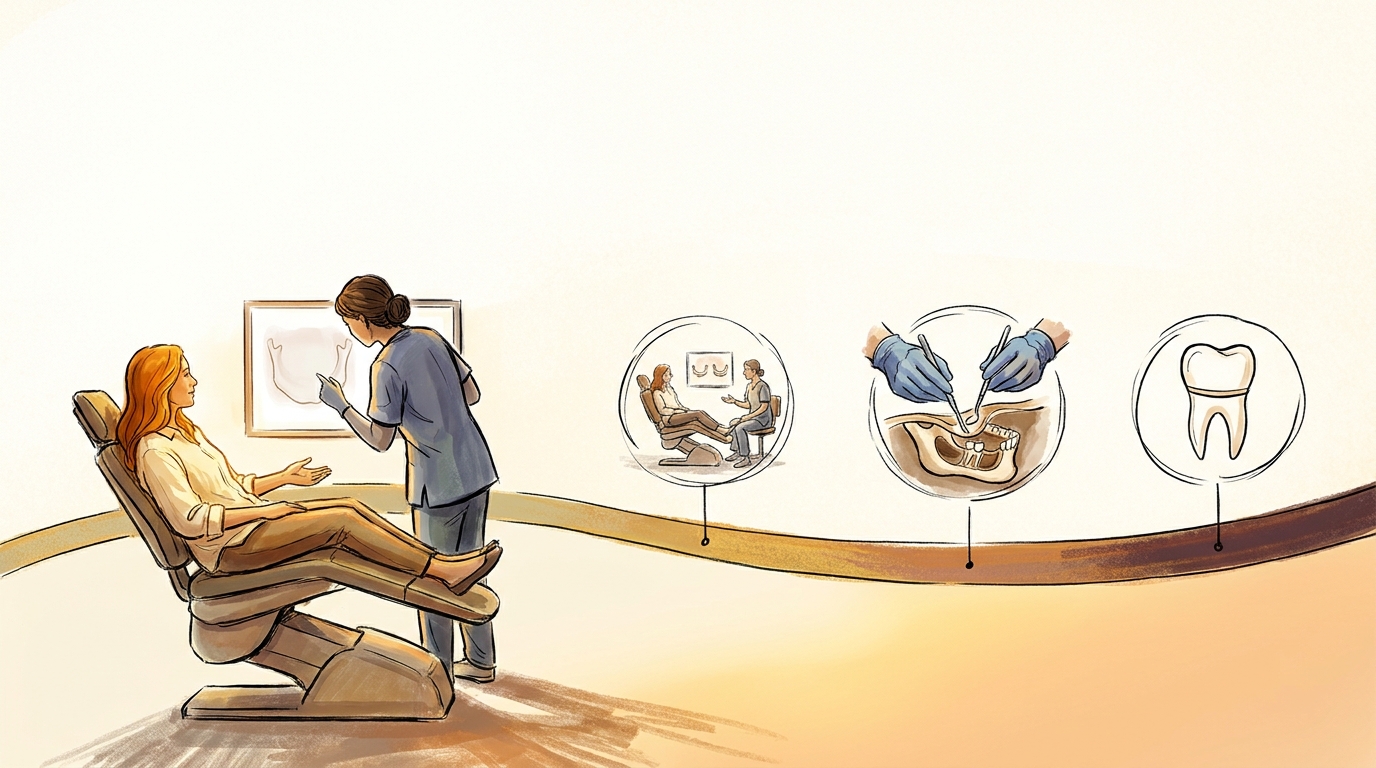
For most patients in Mundelein, IL, a single dental implant takes about 4 to 8 months from the first consultation to the final crown. Cases that require bone grafting or treat multiple teeth typically run 6 to 12 months or longer. The majority of that calendar is healing, not chair time.
The implant itself is a small post placed into the jawbone where a tooth root used to be, and the bone needs time to grow around it before it can hold a crown. That biology — not the surgeon's schedule — sets the pace.
What determines how long dental implants take from start to finish in Mundelein, IL?
Your total timeline depends on four things: your overall health, the amount and quality of bone in your jaw, whether grafting is needed before placement, and how your body heals after surgery. A straightforward single-tooth case in a healthy patient moves fastest. Grafting, sinus proximity, or full-arch work extend the calendar.
A patient's overall health is an important factor in determining candidacy, how long healing takes, and how long the implant may stay in place. Smoking, uncontrolled diabetes, and periodontal disease all slow the process. To be a good candidate, you need adequate bone in the jaw to support the implant and healthy gum tissue free of active disease.
At Markiewicz Dental on IL-83 in Mundelein, implant planning begins with a CBCT scan that maps the exact position of every implant before surgery, which lets us tell you up front whether grafting is likely and how the timeline is going to shape up.
Stage 1: Consultation, imaging, and treatment plan (1–3 weeks)
The first stage is evaluation. We review your medical history, examine the gums and remaining teeth, take 3D CBCT images of the jaw, and build a written plan that lays out the sequence, the stages, and the costs. For most patients this phase takes one to three weeks, depending on scheduling and whether additional specialists need to weigh in.
Markiewicz Dental uses 3D CBCT imaging, AI-assisted X-ray interpretation, and intraoral scanners during this stage, and follows the ALARA principle — taking X-rays only when diagnostically necessary and at the lowest dose that answers the clinical question. Because four doctors practice in one building, including a board-certified periodontist, surgical and restorative planning happens in the same conversation rather than across two offices.
Stage 2: Extractions and bone grafting, if needed (3–6 months of healing)
If a failing tooth still needs to come out, or if the jawbone has already shrunk from an earlier loss, grafting may be the first surgical step. A bone graft performed in advance of implant placement may need 3 to 6 months to heal before implant treatment can proceed.
Not every patient needs this. When the extraction site has enough surrounding bone, we can sometimes place a graft and the implant at the same visit, or place the implant immediately after extraction. Some areas of the jaw present additional challenges due to insufficient bone, and grafting in those cases can add further time before the implant can be placed.
Stage 3: Implant placement surgery (1 day, plus 1–2 weeks of soft-tissue healing)
The implant body — most commonly an endosteal screw, cylinder, or blade — is surgically inserted into the jawbone in place of the tooth's root. Endosteal implants are the most common type, each one designed to hold one or more prosthetic teeth. Surgery itself is usually a single appointment per implant site.
Soft-tissue healing of the gums takes roughly one to two weeks. Bone healing — the part that actually locks the implant in place — takes considerably longer and happens underneath.
How long does osseointegration take in Mundelein, IL?
Osseointegration — the process where jawbone gradually bonds to the surface of the implant — commonly takes 2 to 6 months. During this window the implant is quietly being anchored, and the patient typically has a temporary abutment or provisional restoration in place of the tooth. Nothing visible is happening, but this is the stage that determines whether the implant will succeed long-term.
The healing process for the dental implant body may take several months or longer. Smoking may affect healing and decrease long-term success, which is why we ask patients to stop, or at least pause, during this window.
Stage 4: Abutment and crown placement (2–6 weeks)
Once the implant has integrated, we uncover it and attach the abutment — the connector piece that extends through the gums into the mouth. The abutment is usually attached to the implant body by an abutment fixation screw and supports the final artificial tooth. Gums need a short healing period around the abutment, usually two to three weeks, before the final crown is seated.
From there, a digital scanner captures a 3D model of the teeth and gums — no impression trays, no molds. Markiewicz Dental prints provisionals, night guards, and definitive restorations in-house using 3D digital printing, which tightens the delivery window on the final crown.
Full-mouth and All-on-X timelines in Mundelein, IL
For patients replacing an entire arch, the calendar changes shape. Markiewicz Dental offers All-On-X implants, including fixed full-arch restorations often completed in a single day — meaning extractions, implant placement, and a fixed temporary bridge happen in one surgical visit. The final restoration is delivered after osseointegration finishes, typically 3 to 6 months later.
Full-mouth implant cases are the longest-running on the calendar. Expect several months from first consultation to the definitive prosthesis — longer if extensive grafting is involved.
Typical timeline at a glance
| Stage | Typical duration | What's happening |
|---|---|---|
| Consultation & planning | 1–3 weeks | Exam, CBCT, written treatment plan |
| Bone graft (if needed) | 3–6 months healing | Bone rebuilds before implant can be placed |
| Implant placement | 1 day + 1–2 weeks soft-tissue healing | Implant body inserted into jawbone |
| Osseointegration | 2–6 months | Bone bonds to implant surface |
| Abutment & crown | 2–6 weeks | Abutment placed, final crown delivered |
| Single implant, total | 4–8 months | Straightforward case |
| Full-arch / grafting cases | 6–12+ months | Complex or multi-stage case |
How Markiewicz Dental decides between an implant and other options
Timeline matters, but it's one input among several. Here's how Dr. David Markiewicz frames the decision:
The first thing I look at is the teeth on either side of the gap. A traditional bridge works by putting crowns on those neighboring teeth and attaching the replacement tooth between them. If those teeth already have large fillings or old crowns, a bridge can make a lot of sense, because we're strengthening teeth that need the work anyway. But if they're healthy and untouched, I'm hesitant to grind them down just to hold a bridge. That's when an implant usually becomes my first recommendation, because it replaces the missing tooth on its own without involving the neighbors. Next is the bone and gums. An implant needs enough healthy bone to anchor it, so we take a 3D scan to see exactly what we're working with. If there's been bone loss, Dr. Bogard and I talk about whether grafting makes sense. Because he's in-house, we look at these cases together rather than sending patients back and forth between offices. Then there are some special situations. For a front tooth in a younger patient, or someone who isn't ready for an implant yet, a Maryland bridge can be a great option. It's bonded to the backs of the neighboring teeth with very little drilling. For patients missing several teeth, a partial denture may be the most practical choice, at least to start. Finally, it has to fit the patient's life. Timeline matters: a bridge is usually done in a few weeks, while an implant takes a few months to heal. So does budget and insurance, as well as things like grinding habits and overall health. I always lay out every reasonable option, including the pros and cons of each, and what happens if we leave the space empty. Then our team puts it all in a written plan with the costs. My job is to give my honest recommendation; the decision is always the patient's.— David Markiewicz, Dentist, Markiewicz Dental
A patient's recent first-visit experience is a useful proxy for how the planning stage runs:
From the minute I walked in, a professional team looked after me. X rays, exams, photos, documenting my various levels of rot and decay. For a first visit it was pretty thorough. Friendly staff, knowledgeable Dr. David was articulate, and sharp. First impressions are off the charts. Second impressions even better. They did some major work, and the word “artist” just barely describes the skill of Dr. David. I hate giving a good review, because it will get harder and harder to get an appointment. Why not find out for yourself?5★ · Patient, October 2026
Frequently asked questions
How long do dental implants take from start to finish in Mundelein, IL?
A straightforward single dental implant in Mundelein, IL takes several months from consultation to final crown. Cases involving bone grafting, sinus lifts, or full-arch restorations commonly require a longer timeline. Most of that time is healing — osseointegration alone takes several months — not time spent in the chair.
How long is osseointegration for a dental implant?
Osseointegration — the bonding of jawbone to the implant surface — takes several months to complete. The exact window depends on the location in the jaw, bone quality, overall health, and whether grafting was part of the case. During this period the patient usually wears a temporary abutment or provisional restoration while the implant anchors underneath.
Do I always need a bone graft before a dental implant?
No. Grafting is only needed when the jawbone lacks the volume or density to support an implant. A bone graft performed in advance of implant placement may need 3 to 6 months to heal before the implant can be placed. A 3D CBCT scan during your consultation shows whether grafting is required before surgery is scheduled.
Can a dental implant be placed the same day a tooth is extracted?
Sometimes, yes. When the extraction site has enough healthy surrounding bone and no active infection, an implant can be placed immediately after removing the tooth. This is called immediate placement. Even then, osseointegration still requires several months before the final crown is delivered, so same-day placement shortens the overall calendar only modestly.
How long does a full-arch All-on-X implant case take?
All-on-X fixed full-arch restorations are often completed in a single surgical day, meaning extractions, implant placement, and a fixed temporary bridge happen in one visit. The definitive, final prosthesis is delivered after osseointegration finishes, typically 3 to 6 months later. Plan on several months from consultation to the final restoration.
What can slow down my dental implant timeline?
Smoking, uncontrolled diabetes, active periodontal disease, inadequate bone, and sinus proximity in the upper back jaw all extend the timeline. Smoking in particular may affect healing and decrease long-term implant success. Overall health is a major factor in how long healing takes and how long the implant stays in place, which is why health history is reviewed in detail at the consultation.
The short version
Dental implants aren't fast, but the calendar is predictable once planning is done well. For most Mundelein, IL patients, a single implant runs 4 to 8 months and a full-arch case runs 6 to 12 months or longer, with osseointegration doing most of the quiet work in the middle. The practices that keep timelines on track are the ones that plan surgery and restoration together from day one.
Readers in Mundelein, IL who want implant planning handled under one roof — with surgical and restorative care, CBCT-guided planning, and in-house printing of provisionals and final restorations — can reach Markiewicz Dental at 852 IL-83 by calling (847) 566-2811 or visiting https://www.amdds.com to schedule a consultation.