
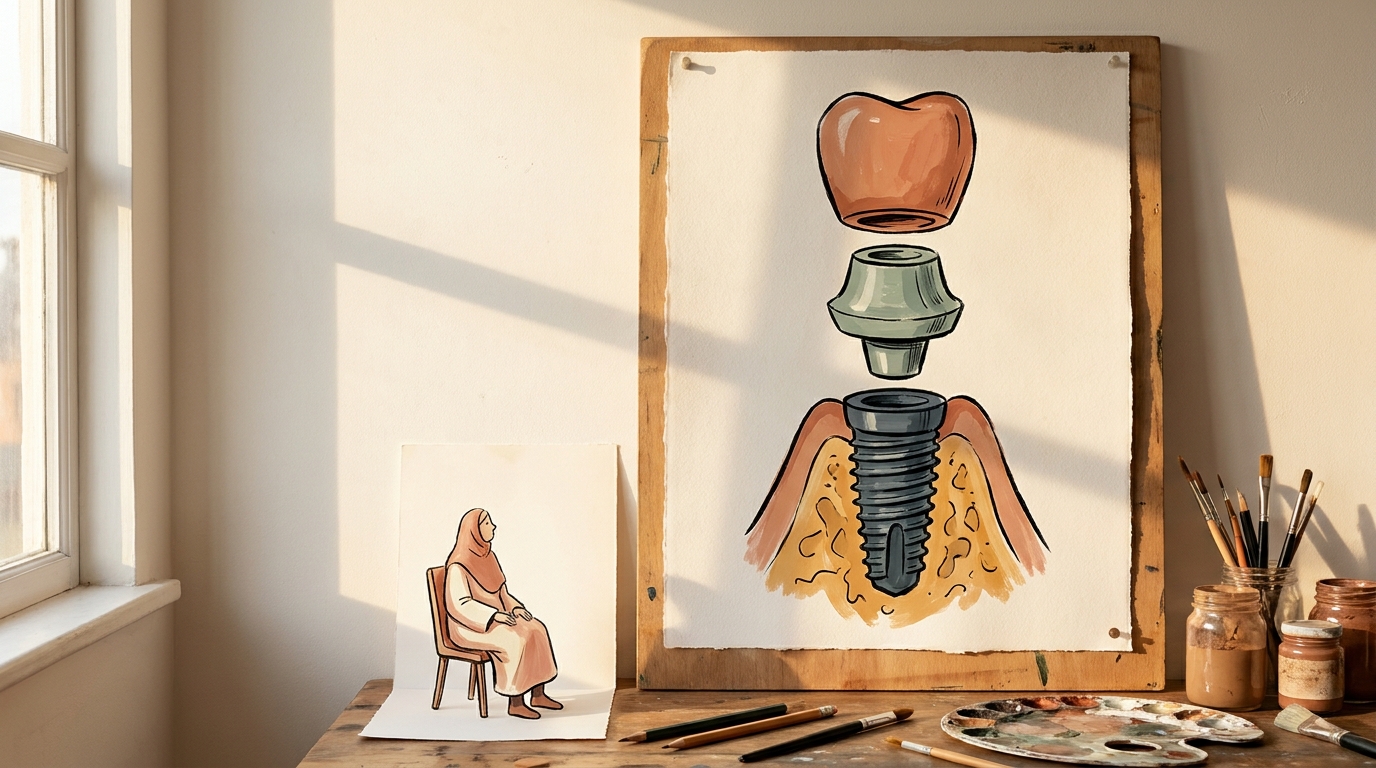
A dental implant is a medical device surgically placed in the jawbone to replace a missing tooth's root, with a crown, bridge, or denture attached on top. For most healthy adults in Mundelein, IL with adequate jawbone and no active conditions that impair healing, implants are a durable, bone-preserving way to replace one tooth, several teeth, or a full arch — provided you're prepared for a treatment timeline measured in months, not weeks.
That's the straight answer. The rest of this guide explains how implants work, who they're genuinely right for, who should pause, and what the process looks like locally.
What exactly is a dental implant, and how does it work?
A dental implant system has three parts: an implant body placed in the jawbone, an abutment that extends through the gums, and an abutment fixation screw that connects them, according to the FDA. The implant body fuses to bone through osseointegration, then supports an artificial crown, bridge, or denture on top.
Unlike a bridge, an implant replaces the tooth root rather than just the visible crown — which is why it preserves bone where a bridge does not.
At Markiewicz Dental in Mundelein, implant planning uses CBCT scanning, which allows the exact position of every implant to be planned before surgery. A 3D intraoral scanner replaces traditional impression trays, capturing a digital model of the teeth and gums without molds. These are standard tools in a modern implant workflow, not optional add-ons.
Who is a good candidate for dental implants?
Good candidates are generally adults with healthy gums, enough jawbone to anchor the implant, and no uncontrolled chronic illness that would interfere with healing. The FDA lists overall health as a key factor in whether a patient is a good candidate, how long healing takes, and how long the implant stays in place. Age itself is not a disqualifier.
The ADA notes that chronic illnesses such as diabetes or leukemia may interfere with healing after implant surgery, and patients with these conditions may not be good candidates. Smoking is the other big one — the FDA states that smoking may affect healing and decrease the long-term success of an implant. Neither is an automatic no, but both change the risk conversation.
Gum disease history matters too. A retrospective study with a 10-year follow-up of patients treated for chronic periodontal disease found implant loss ran about 10 times higher than natural tooth loss (0.4 implants per patient per year versus 0.04 teeth lost for periodontal reasons). The lesson isn't that implants fail — it's that patients with a periodontal history need ongoing maintenance to protect them. Because Markiewicz Dental has a board-certified periodontist on staff, gum therapy and implant work happen under one roof without an outside referral.
How long does the implant process take?
Plan on several months from placement to final tooth. After the implant body is placed, the implant and bone are allowed to bond together over two to six months to form an anchor for the artificial tooth, according to the American Academy of Periodontology.
The timeline has three broad stages:
| Stage | What happens | Typical duration |
|---|---|---|
| Planning & placement | CBCT imaging, treatment plan, surgical placement of the implant body | 1–2 visits |
| Osseointegration | Bone grows around the implant; temporary abutment in place | 2–6 months |
| Restoration | Abutment and final crown, bridge, or denture attached | 1–3 visits |
Some cases move faster. Markiewicz Dental offers All-On-X fixed full-arch restorations often completed in a single day, and prints provisionals and definitive restorations in-house using 3D digital printing for a more accurate fit in fewer visits. But the biology of osseointegration still governs the long game — the ADA is clear that bone growth around the implant can take up to several months before replacement teeth can be attached.
Implant vs. bridge: which is right for a single missing tooth?
For most healthy adults missing one tooth, an implant is the better long-term choice because it preserves jawbone. A tooth-supported fixed bridge requires that adjacent teeth be ground down to support the cemented bridge, according to the AAP, and the bone that previously surrounded the missing tooth begins to resorb underneath it. An implant integrates with the jawbone and helps keep that bone intact.
Bridges still have a role — faster timeline, sometimes lower upfront cost, useful when adjacent teeth already need crowns. But when the neighboring teeth are healthy, grinding them down to fix a different problem is a trade most patients regret within a decade. And ignoring a missing tooth isn't neutral either: the FDA warns that tooth loss can lead to rapid bone loss, defective speech, and changes in chewing patterns that cause discomfort.
What about short implants or cases with limited bone?
Short implants (6 millimeters or less) are a legitimate option when bone height is limited. A systematic review of 19 randomized controlled trials found that short implants (6 millimeters or less) and long implants (10 millimeters or more) had comparable five-year survival rates in nonaugmented bone and full-mouth rehabilitation.
This is where imaging and planning earn their keep. Markiewicz Dental uses 3D CBCT imaging and AI-assisted X-ray interpretation to provide a second set of expert eyes on every image, and follows the ALARA principle — taking X-rays only when diagnostically necessary and at the lowest dose that answers the clinical question. That planning determines whether a short implant, a graft, or a different approach fits your anatomy.
What should Mundelein, IL patients ask before starting?
Dr. Tony Markiewicz, the practice's founder, on the questions patients rarely think to ask:
After practicing since 1988, I've seen a lot of dental work over its full lifetime. Some of the crowns I placed in my early years are still going strong today. Others didn't last nearly as long. The difference usually comes down to questions patients never thought to ask at the start. The first is "How long should this realistically last, and what shortens it?" No dental work lasts forever, but grinding, skipped cleanings, and certain habits can cut its life short. Knowing that up front helps you protect your investment from day one. The second is "What happens if something goes wrong?" Here, if anything we've done needs to be redone within the first year after completion, we take care of it at no charge. In years two and three, we offer a 50% courtesy. Patients should ask any office this question, because not every practice stands behind their work the same way. The third is "Will my insurance help replace this someday?" Many plans, including Delta, will only pay to replace a crown or bridge after a certain number of years, often around five. If something fails before then, you may be paying out of pocket. Patients also rarely ask about materials. Zirconia, porcelain, and porcelain fused to metal each have their strengths depending on where the tooth is and how hard you bite. Some insurance plans only cover the cost of a less expensive material, so it's worth understanding the difference before deciding. And finally, "What will it take to maintain this?" That might mean a night guard, more frequent cleanings, or special tools to clean around an implant or bridge. The best dental work is a partnership. We do our part in the chair, and you do yours at home. When patients ask the right questions early, everyone wins.— Tony Markiewicz, Dentist/Founder
A recent patient review captures what the experience looks like on the other side of the chair:
I am a nervous (ok, terrified) patient with hereditarily fragile teeth. I am consistently blown away by the kindness and patience with which both Doctors and their staff treat me. Every step is explained, any accomodation is made. They listen to concerns and work with the patient to make sure that the treatments are completed on your schedule, to your comfort level and aligned with your insurance calendar. The billing staff are straightforward and respectful, the equipment / office space is state of the art, and the environment is just pleasant.I cannot say enough good things about this practice.
Frequently asked questions
Are dental implants painful?
Implant placement is a surgical procedure done with local anesthesia, and most patients report the discomfort afterward is comparable to a tooth extraction — manageable with standard pain relievers for a few days. Swelling and soreness are normal for about a week. Osseointegration itself, the months-long bone-healing phase, is not painful. Your dentist will tailor sedation and post-op medication to your health history.
How long do dental implants last?
Longevity depends on oral hygiene, overall health, and habits like smoking, per the FDA. In a 10-year study of patients with treated chronic periodontitis, implant loss ran approximately 10 times higher than natural tooth loss due to periodontal disease. In healthier patients with good maintenance, implants routinely last decades. No dental work is permanent — grinding, skipped cleanings, and gum disease all shorten it.
Can I get an implant if I smoke or have diabetes?
Possibly, but with caution. The FDA notes smoking may affect healing and decrease long-term implant success, and the ADA states that chronic illnesses such as diabetes or leukemia may interfere with healing. Well-controlled diabetes often doesn't disqualify a patient, but uncontrolled disease or active smoking significantly raises failure risk. A full medical history review before planning is essential.
Do I need a bone graft before getting an implant?
Only if imaging shows insufficient bone volume or height to anchor the implant. CBCT scanning determines this before surgery. In some cases, short implants (6 millimeters) can be placed instead of grafting — a systematic review found short and long implants had comparable five-year survival rates in nonaugmented bone. Your treatment plan depends on your specific anatomy.
What's the difference between a single implant and All-On-X?
A single implant replaces one tooth with one implant body and one crown. Markiewicz Dental offers All-On-X restorations often completed in a single day, while traditional single implants follow the standard two-to-six-month osseointegration timeline.
Where can I get dental implants in Mundelein, IL?
Markiewicz Dental, located at 852 IL-83 in Mundelein, provides implant planning, surgical placement, and final restoration in-house. The practice has four doctors in one building, including a board-certified periodontist, so grafting, gum work, and implant placement happen without an outside referral. The practice is family owned and has never been corporate-owned.
The bottom line
Dental implants are the closest modern dentistry comes to replacing a natural tooth — root and all. They preserve bone, they don't damage neighboring teeth, and with reasonable maintenance they last for decades. The right candidates are healthy adults willing to invest in a months-long process; the wrong ones are patients with untreated gum disease or uncontrolled chronic illness who skip the groundwork.
If you're in Mundelein, IL and weighing whether implants are right for you, Markiewicz Dental can be reached at (847) 566-2811 or at https://www.amdds.com. A planning visit — CBCT scan, health history, honest conversation about timeline and alternatives — is the right first step, whether you end up choosing an implant or something else.